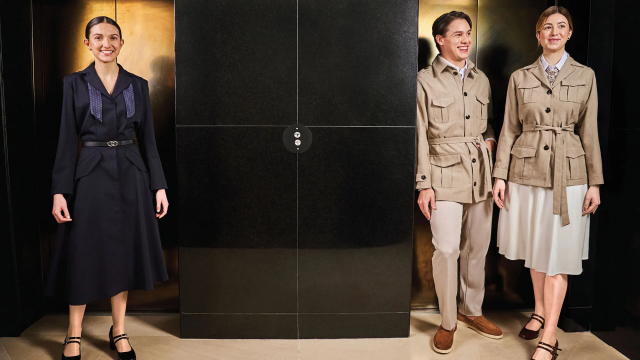
Upscale hotels give new attention to staff attire
2026-03-30
Just over a year ago, I wrote a column recapping some industry observations shared by Tyler Brule, editorial director at Monocle, a global affairs and lifestyle magazine and media platform, during his stage presentation at the 2024 International Luxury Travel Market in Cannes, France.
Chief among his criticisms was a growing issue with hotel uniforms, which he said had become so nondescript that staff had sometimes become indistinguishable from guests.
“Everyone is wearing a version of a Loro Piana loafer,” he said in his speech. “Everyone’s got a nice chino with a nice blazer. They just have some sort of a small rosette, and you’re not sure if they’ve won a national prize or if they’re actually supposed to be serving you.”
His solution was to bring back the proper uniform, not simply for the sake of formality but as an extension of brand identity.
“I think as much as you focus on a great logo and having great architects and designers, it’s also part of the brand to have outstanding uniforms,” Brule said.
It would appear that the industry heard him loud and clear: A number of high-end hotels are taking a decidedly more elevated approach to what their teams wear.
Last May, ahead of the Waldorf Astoria New York’s reopening, Hilton unveiled uniforms for the property designed by NO Uniform, a studio led by British couture designer Nicholas Oakwell, whose previous clients have included upscale brands like Raffles and Mandarin Oriental. Inspired by the Waldorf’s art deco heritage, highlights include silver silk blazers and waistcoat suits for front-of-house staff and velvet blazers and floor-length sequin gowns for hosts at the hotel’s famed Peacock Alley bar.
Earlier this year, Accor’s Sofitel brand debuted Le Vestiaire, a uniform collection developed with Cordelia de Castellane, a French designer and artistic director with Dior. Featuring a palette of navy blue, off-white, beige and denim blue, the more than 45-piece line was designed to be mixed and matched, giving staff the flexibility to adapt their look to their role, culture and climate. Key pieces include a tailored vest that can be paired with pleated trousers or a midi-skirt as well as scarves, shirts, dresses and ties featuring an exclusive Sofitel monogram print.
The theme of elevated uniforms resurfaced at an industry conference yet again this year, when I met Zachariah Simons, head of client services for Jalin Design, a London-based studio specializing in luxury garments for the hospitality sector and other industries. We connected at Forbes Travel Guide’s The Summit in Monaco in late February, where several of Jalin’s exquisitely tailored designs were on display.
“It’s moved from being a uniform conversation into a brand conversation,” he said. “A few years ago, it was still led by the practical side: cost, durability, replacement cycles. That hasn’t gone away, but it’s no longer where things start.”
According to Simons, a well-designed uniform can also help empower staff.
“When something is well cut, considered and comfortable, people carry themselves differently,” he said. “There’s a level of confidence that comes through quite naturally.”
And while most guests may never notice what the front desk team is wearing or mention it in a Tripadvisor review, Simons said the impact that well-designed garments can have on the overall guest experience shouldn’t be underestimated.
“Guests don’t necessarily analyze it directly, but they do register it,” he said. “Uniforms help establish clarity. When it’s right, it contributes to that sense that everything has been considered. Uniforms sit alongside lighting, scent, sound. They become part of the overall atmosphere.”
Courtesy of Travel Weekly