Design-Led Escapes: Hotels and Spaces Worth Traveling For This Spring
2026-04-06 Richard Shane
Founder and CEO
The World’s Greatest Vacations
There was a time when a hotel was simply where a trip began and ended. Today, the most compelling journeys are often shaped by the spaces themselves.
Design-led travel is not about decoration or trend, but about intention. It is the alignment of architecture, landscape, light, and material that transforms a stay into something immersive. These are places that do not compete with their surroundings, they interpret them.
Spring, with its transitional energy and renewed light, is the ideal moment to experience these environments. Not at full capacity, not overly staged, but as they were meant to be lived in.
Architecture That Frames the Experience
The most memorable spaces do not demand attention, they guide it.
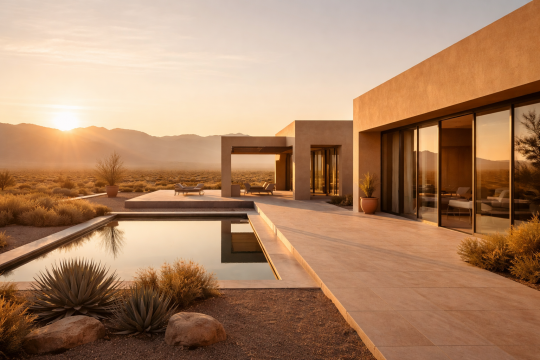
In the Cyclades, low-slung structures mirror the horizon, allowing the sea to remain the focal point. In the desert landscapes of the American Southwest, clean geometric forms sit quietly against vast open terrain, creating contrast without disruption. In Scandinavia, timber and glass blur the boundary between interior and exterior, inviting the landscape inward.
What defines these places is restraint. Architecture becomes a lens rather than a statement, shaping how light enters, how views unfold, and how a traveler moves through the space.
Materiality and the Return to Texture
Luxury is increasingly tactile.
Stone that retains the warmth of the afternoon sun. Linen that softens with time. Wood that carries the subtle imprint of craftsmanship. These elements are not ornamental, they are experiential.
Design-forward properties are moving away from polished uniformity toward something more grounded. Materials are chosen for how they age, how they respond to light, and how they connect to their environment.
This creates a sense of continuity. The space does not feel imposed, it feels discovered.
Light as a Design Element
Spring light has a particular quality, directional, soft, and constantly shifting.
The best-designed spaces anticipate this. Rooms are oriented to capture early morning clarity or late afternoon warmth. Openings are deliberate, framing not just views but moments of the day.
In Japan, minimalist interiors allow light to define the space itself. In southern Europe, shutters and terraces modulate brightness, creating layers of shadow and depth. In alpine regions, expansive glazing turns the surrounding landscape into a living backdrop.
Light becomes part of the architecture. It changes the experience hour by hour, ensuring that no two moments feel the same.
Spaces That Encourage Slower Living
Design-led escapes are not built for speed.
They encourage pause. A long corridor that reveals a view gradually. A courtyard that invites you to sit without purpose. A room that feels complete without needing to leave it.
This is particularly relevant in April. Without peak-season intensity, these spaces can be experienced fully, without interruption or distraction.
The result is a different kind of itinerary. Less structured, more intuitive. Time is not filled, it is allowed.
Destinations Where Design Defines the Journey
Certain regions have become synonymous with this approach.
In Portugal’s Alentejo, understated estates blend into rolling landscapes, prioritizing silence and scale. In Mexico’s Baja California, raw materials and open structures respond directly to desert and sea. In northern Italy, restored villas balance heritage with contemporary restraint.
What unites them is a commitment to place. Design is not imported, it is rooted. The experience feels specific, not replicable.
Travel becomes less about where you go next, and more about where you choose to stay.
Closing Thought
As travel continues to evolve, the role of design becomes more central.
It is no longer an added layer, but a defining one. The right space can slow a journey down, sharpen perception, and create a lasting sense of connection to a place.
Spring is the ideal time to seek this out. Before destinations reach their peak, before spaces become fully occupied, there is an opportunity to experience them as intended.
Not as a backdrop, but as the destination itself.