The Journey Has a View Again
2026-08-10 Richard Shane
Founder and CEO
The World’s Greatest Vacations
For much of modern travel, movement became the part to minimize. The fastest flight, the shortest connection and the quickest route from terminal to hotel were considered signs of a well-planned journey. Distance was something to overcome before the experience could begin.
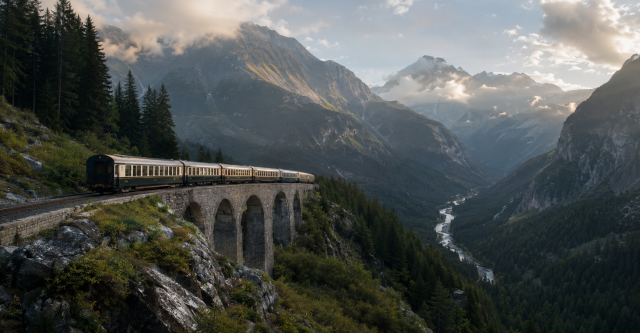
Train travel offers a different proposition. The landscape remains visible, arrival happens gradually and the hours between two places regain their character. A meal is served while vineyards pass the window. Mountains appear in the distance, draw closer and eventually surround the train. Cities announce themselves through suburbs, church towers and platforms filled with local life.
The journey is no longer an interruption. It becomes part of the reason for leaving.
Distance Becomes Visible Again
Air travel is remarkably effective at concealing geography. A traveller enters one terminal, spends several hours in a controlled interior and emerges somewhere entirely different. The distance has been crossed, but rarely experienced.
From a train window, the relationship between places becomes legible. Northern plains rise toward the Alps. Scottish cities give way to lochs and open moorland. Between Rome and the Italian coast, apartment blocks, farms, industrial towns and umbrella pines form an evolving portrait of the country that no single destination can provide.
These transitional landscapes are rarely included in an itinerary, yet they often become some of its most enduring images. They reveal how a place changes beyond its celebrated centre, adding context to everything encountered after arrival.
A Room That Refuses to Stay Still
The most compelling trains create an unusual tension between intimacy and movement. Inside, there may be polished wood, linen-dressed tables and the quiet order of a private cabin. Beyond the glass, the scenery changes continuously.
This contrast gives rail travel much of its atmosphere. A hotel room usually asks guests to admire a fixed view. A train offers hundreds of them, none available for more than a moment. The experience encourages attention because it cannot be paused or revisited.
Design plays a central role. The best modern rail interiors resist turning the past into costume. Heritage details may remain, but they are balanced with contemporary lighting, thoughtful acoustics and spaces that feel comfortable rather than theatrical. The romance survives because it has been edited, not merely reproduced.
The Return of Unscheduled Time
A long rail journey creates hours with very few demands. There is no museum reservation to reach, no route to navigate and no need to decide where to eat. The traveller’s responsibility is temporarily reduced to watching, reading, talking or doing nothing at all.
This unclaimed time has become increasingly rare. Even on vacation, days are often organized around timed entry, restaurant bookings and the pressure to use every hour well. On a train, the itinerary is already in motion. Progress continues without anyone having to manage it.
Meals take on a different rhythm too. Lunch is not a pause between activities. It is the activity, unfolding over several landscapes while the light and weather change outside. Conversation becomes easier when nobody is waiting for the next item on the schedule.
Night Changes the Experience
Day trains reveal the geography between destinations. Sleeper trains introduce something more dreamlike. A city platform disappears after dinner, the movement of the carriage becomes familiar and morning arrives in a landscape that feels impossibly far from the one left behind.
There is a satisfying practicality to this form of travel. The night is not lost to an airport hotel or an early transfer. Yet its deeper appeal lies in the sense of passage. Falling asleep in one country and waking in another makes distance feel both real and slightly mysterious.
Luxury rail operators have begun interpreting this experience with greater confidence. England and Wales welcomed their first luxury sleeper train in 2025, while established journeys through Scotland, continental Europe, Africa, Asia and the Andes continue to attract travellers who want the route itself to carry meaning.
Old Romance, New Reasons
The renewed interest in rail is often explained through nostalgia. Dining cars, brass fittings and uniformed service recall an era when travel appeared more elegant. Nostalgia is certainly part of the attraction, but it does not fully explain why trains feel relevant now.
Their modern appeal comes from qualities that have become scarce: uninterrupted time, visible landscapes, a sense of sequence and the ability to travel without constantly changing environments. A train can be private without feeling isolated, social without being crowded and luxurious without requiring spectacle.
Recent traveller research reflects that interest. In American Express Travel’s 2026 report, luxury rail was the most popular choice among surveyed travellers interested in modern interpretations of historic journeys. The result suggests that travellers are not seeking a perfect recreation of another age. They want its sense of occasion translated into the present.
The Pleasure of Gradual Arrival
Perhaps the greatest difference appears at the end. A train does not release its passengers into the controlled anonymity of an airport. It slows among buildings, crosses familiar streets and arrives near the centre of everyday life.
There is time to gather a coat, finish a conversation and watch the destination come into focus. The transition is gentle enough for anticipation to build, yet direct enough that the journey still feels connected to the place.
Speed will always matter. Some trips need to be compressed, and flight has made the world accessible in ways rail never could. But when time allows, there is something quietly luxurious about refusing to skip the space in between.
The view is only part of it. What has truly returned is the pleasure of getting there.