Lower Manhattan’s tourism renaissance, 25 years after 9/11
2026-09-21
When hospitality veteran Prince Sanders left the former Ritz-Carlton New York, Battery Park in 2014 for a new hotel job in Midtown Manhattan, he swore to colleagues he’d never work downtown again.
“Ritz-Carlton was a luxury anchor downtown, but I really struggled to serve guests there,” said Sanders. “No matter what anyone wanted to do, I was always sending them back to Midtown. You want theater, back up to Midtown. You need to do some shopping, I had to send you back up to Midtown.”
But 12 years later, Sanders is back in Lower Manhattan as general manager of The Wall Street Hotel, which opened in 2022. The hotel is part of Preferred Hotels & Resorts’ L.V.X. Collection of luxury properties.
His willingness to return, he said, is proof of just how much the neighborhood has changed. “Downtown has evolved so much,” he said. “I’ve often referred to it as a renaissance.”
That renaissance comes 25 years after the 9/11 attacks reshaped Lower Manhattan. The area has since rebuilt into a tourism and hospitality hub, home to 40-plus hotels at a range of price points, Michelin-starred restaurants and cultural attractions, including the 9/11 Memorial & Museum.
In 2001, the neighborhood had just a handful of hotels, according to Jessica Lappin, president of the Alliance for Downtown New York.
“When you think back to 25 years ago, pre-9/11, people who were coming to stay in the neighborhood were overwhelmingly business travelers,” said Lappin. “And what’s been fascinating is how many leisure travelers are now coming to stay.”
Lappin has had a front-row seat to that demographic shift during her 12-year tenure with the alliance.
“When I first started, it felt like I was going to a ribbon-cutting every week, from the opening of the Oculus to Brookfield Place to One World Trade to The Beekman Hotel,” said Lappin.
She called The Beekman, a hotel that’s part of Hyatt’s Thompson brand, a “pioneer” that helped put Lower Manhattan on the map for a more leisure-focused brand of boutique luxury hospitality.
With more hotels also came a wave of destination dining. Lappin pointed to restaurants like the Michelin-starred Crown Shy and Saga and Union Square Hospitality Group’s Manhatta. Famed chefs have set up shop, including Daniel Boulud and Tom Colicchio, who have restaurants in the Beekman; Wolfgang Puck brought his name to the Four Seasons Hotel New York Downtown, which opened in 2016.
Marcus Samuelsson’s Metropolis restaurant anchors the Perelman Performing Arts Center, a theater venue that opened at the World Trade Center site in 2023.
Retail has similarly kept pace. Sanders is now able to point guests to nearby options like the high-end French department store Printemps, a Wall Street outpost of luxury jeweler Tiffany & Co. or the Westfield World Trade Center mall.
Attraction and entertainment options are also growing, bolstered by newer additions like Mercer Labs, billed as an “immersive” museum of art and technology, and the Balloon Museum New York, which debuted its permanent location this summer at the Tin Building in Lower Manhattan’s Seaport district and features large-scale, inflatable art.
The neighborhood’s waterfront setting has added to its appeal for leisure tourism.
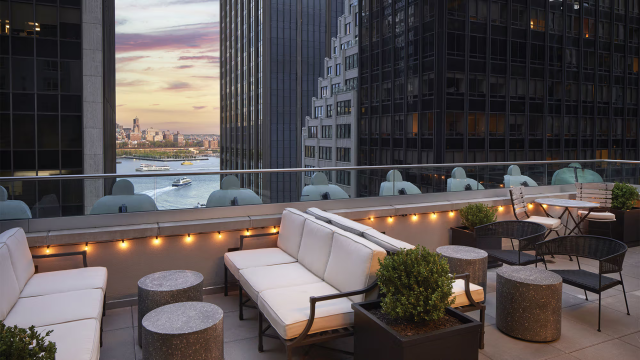
Richie Karaburun, a clinical associate professor at New York University’s Jonathan M. Tisch Center of Hospitality and co-author of the book “Nation and Place Branding: An Applied Approach to Building the Image of Countries, Regions and Cities,” attended a travel industry event atop a rooftop venue at The Wall Street Hotel earlier this summer and was “mesmerized” by the views.
“When I look at all my favorite cities, the common denominator is a waterfront,” said Karaburun. “And when I saw the waterfront from the 15th floor of that rooftop bar, I felt like I was in a totally different city. I was in awe.”
According to Tiffany Townsend, executive vice president of global communications for NYC Tourism + Conventions, Lower Manhattan has now become “a destination within a destination.”
“It’s been really positive to see everything that’s developed, with all the hotels that have opened up, all the dining and that cultural piece that has expanded,” said Townsend. “It’s been a draw for getting guests to stay in the neighborhood, but it’s also a draw for travelers staying elsewhere.”
Lappin said, “People would, historically, just come downtown to take the Staten Island Ferry or visit the Statue of Liberty. Now, it’s a must-see neighborhood.”
Courtesy of Travel Weekly