Altitude Without Effort: Elevated Escapes That Redefine Mountain Travel
2026-05-10 Richard Shane
Founder and CEO
The World’s Greatest Vacations
Mountain travel has long been associated with exertion, steep climbs, dense winter crowds, or rugged isolation. But a quieter evolution is taking place at higher elevations.
A new generation of alpine and mountain destinations is redefining the experience through design, accessibility, and atmosphere. These are not places centered around performance or spectacle, but around perspective. The emphasis has shifted from activity alone to how it feels to exist within the landscape.
The result is a more refined relationship with altitude, one built around ease rather than effort.
The Shift Away from Traditional Alpine Culture
For years, mountain travel followed a familiar formula. Winter-focused itineraries, heavily scheduled activity, and destinations built almost entirely around ski infrastructure.
Today, travelers are seeking something broader.
Mountain environments are increasingly valued for their clarity, scale, and emotional effect rather than a single activity. Travelers want the atmosphere of elevation without needing to structure an entire journey around performance.
This has transformed the way destinations position themselves. Architecture has become softer and more integrated. Wellness has become central rather than secondary. Seasonal flexibility matters more than ever.
The mountain is no longer simply the backdrop. It is the experience itself.
Design That Connects to Landscape
The most compelling elevated escapes are deeply connected to their surroundings.
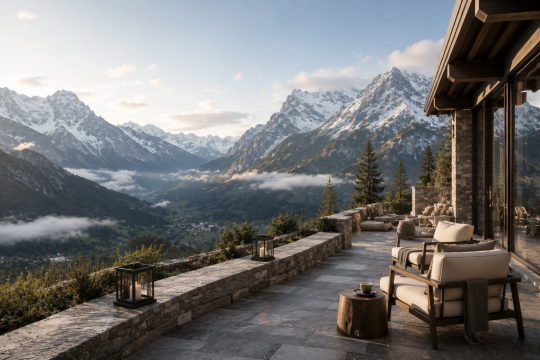
Large panoramic glazing replaces ornamental interiors. Materials become quieter and more tactile, stone, untreated wood, natural textiles, brushed metals. Spaces are designed to frame weather, light, and scale rather than compete with them.
At higher elevations, atmosphere changes constantly. Clouds move quickly. Light shifts by the minute. Snow lingers on distant peaks while valleys transition into green.
Design-led mountain properties understand this rhythm. Rooms become observatories. Lounges feel intentional rather than decorative. The experience slows naturally because the environment already holds attention.
Wellness Without Performance
Altitude changes physical perception. Air feels sharper. Sound softens. Distance becomes more visible.
Many modern mountain retreats are building around these qualities rather than around activity schedules. Wellness programs are quieter and more architectural, thermal circuits integrated into stone environments, open-air pools facing ridgelines, treatment rooms positioned toward landscape rather than inward.
The focus is restoration rather than optimization.
This creates a very different atmosphere from traditional luxury wellness travel. Less curated intensity, more environmental calm.
Destinations Leading the Shift
The Alps continue to evolve beyond their winter identity. Regions in Switzerland, Austria, and northern Italy are increasingly attractive during shoulder and summer periods, when trails, lakes, and villages feel more spacious and balanced.
In Japan, mountain regions surrounding Nagano and Hokkaido offer a distinctly minimalist interpretation of alpine travel, combining natural hot springs, restrained architecture, and strong seasonal atmosphere.
In Patagonia, elevation becomes more elemental. Vast landscapes dominate perception, and luxury is defined less by decoration than by remoteness, silence, and precision of experience.
Despite their differences, these destinations share a common philosophy, they allow the environment to lead.
Movement at a Different Pace
One of the defining characteristics of elevated travel is the change in rhythm.
Movement becomes slower, not because of limitation, but because the environment encourages it. Mornings begin earlier. Distances feel larger. Weather shapes decisions naturally.
This alters how travelers engage with time. Days become less segmented. Activities emerge organically from conditions rather than schedules.
The experience feels less programmed and more responsive.
The Emotional Appeal of Elevation
There is also something psychological about higher landscapes.
Elevation creates separation, from noise, density, repetition, and urgency. Perspective expands physically and mentally at the same time.
This may explain why mountain travel increasingly appeals even to travelers who are not traditionally drawn to outdoor activity. The value is not necessarily adventure, but clarity.
At altitude, space feels more visible. So does stillness.
Closing Thought
Mountain travel is evolving from something active to something immersive.
The most refined elevated escapes are no longer defined by intensity or exclusivity, but by atmosphere, pacing, and connection to landscape.
They offer a version of luxury that feels quieter, more architectural, and more emotionally grounded.
Not escape from the world entirely, but enough distance to see it differently.