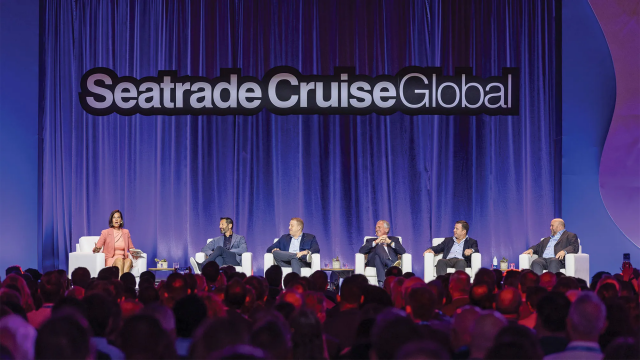

MIAMI BEACH — Iran’s wartime closure of the Strait of Hormuz has caused disruptions and rising prices worldwide. But cruise executives at the Seatrade Cruise Global conference here last week described the industry as well positioned to weather the volatility.
During the State of the Global Cruise Industry panel last week, Carnival Corp. CEO Josh Weinstein said the industry was in a much stronger position than it was during the oil crisis of summer 2008, when the cruise lines levied fuel surcharges because oil prices soared to as high as $147 per barrel.
Executives on the panel were not asked if fuel surcharges were a possibility in 2026.
But the cruise industry is larger now than it was 15-plus years ago, Weinstein said, which makes it more capable of withstanding economic volatility.
The industry continues to pursue alternative fuels, said Royal Caribbean Group CEO Jason Liberty; less reliance on oil would mean the industry would be less impacted by spiking prices. “We’re trying to push to make sure they’re available,” he said.
The industry’s economic resilience was a core theme of the discussion, which featured the top CEOs of the four largest cruise companies and was moderated by CNBC correspondent Contessa Brewer.
Weinstein said the industry was protected during moments of economic strain due to its value relative to land-based vacations.
“We offer a ridiculous value gap to other vacation alternatives, and so we are incredibly well positioned if the world gets tougher and if there’s less disposable income,” he said.
Norwegian Cruise Line Holdings CEO John Chidsey said it was amazing “what you get for the dollar” on a cruise.
“I think our industry is positioned phenomenally well, given the challenges we face,” he said.
While the panel’s tone toward economic stressors was positive, the war has also physically impacted some ships’ ability to operate. Six cruise ships, including the MSC Euribia, were sailing the Arabian Gulf when the fighting broke out.
Those ships remain in the region. Pierfrancesco Vago, executive chairman of MSC Group’s cruise division, described the situation as fluid and requiring constant monitoring.
“We need to stay cool and be ready to move out as soon as the opportunity comes,” he said.
Managing overtourism and social media
Panelists also spoke about the ongoing challenges that come with running a modern cruise company, including overtourism and the potential for negative sentiments about their products to circulate on social media.
Vago described overtourism as primarily an issue of perception. Cruise lines are planning arrivals in ports years in advance and work with ports to try to control the flow of passengers.
“We represent a very little piece of the whole bigger equation,” he said.
Royal Caribbean Group is developing private destinations at a faster rate than any other cruise company, Liberty said; he described those destinations as one solution to overtourism concerns because they “spread the distribution of where the guests go.”
The panelists acknowledged that cruising still faces negative perceptions on social media. Brewer referenced, though not by name, the Netflix documentary “Trainwreck: Poop Cruise,” about the Carnival Triumph’s 2013 power outage.
The best way to counter those perceptions is to develop passenger experiences that elicit positive messaging, Weinstein said. Those voices can “crowd out the vocal minority,” he added.
The companies also see social media as a tool for evaluating the guest experience in real time, Liberty said.
The State of the Industry was the first to feature Chidsey, who was named CEO of Norwegian Cruise Line Holdings just two months ago.
His background is in executive leadership in restaurants, including Subway and Burger King. When Brewer asked what “a sandwich guy” knows about cruising, he pointed to his experience with company turnarounds. He has been credited for improving both Subway and Burger King when they were facing challenges and said that turnaround work is something he enjoys.
Plus, “cruising is a great industry,” he said. “There’s just so much upside.”