Slow Openings: Journeys That Begin with Space, Silence, and Intentional Pace
2026-04-13 Richard Shane
Founder and CEO
The World’s Greatest Vacations
Not every journey needs to begin with movement.
There is a growing shift in how experienced travelers approach arrival. Instead of rushing into itineraries, checklists, and reservations, the most refined trips now begin with something far less structured, space.
April creates the ideal conditions for this. Destinations are open, but not yet crowded. Energy is present, but not overwhelming. It becomes possible to arrive without urgency, to let the environment set the rhythm rather than imposing one.
This is the concept of the slow opening, the first 24 to 48 hours of a trip designed not to explore outward, but to settle inward.
Arrival Without Immediate Intention
Most travel begins with compression. Flights, transfers, check-ins, followed by an immediate push to “make the most” of the destination.
The slow opening reverses this.
Arrival becomes a transition, not a trigger. The first moments are intentionally unstructured. A walk without direction. Sitting without a plan. Observing rather than engaging.
This is not inactivity. It is calibration.
By removing the pressure to act, travelers begin to absorb a place more naturally. The sounds, the pace, the subtle differences in light and movement become noticeable. What might otherwise be missed becomes foundational.
Environments That Support Stillness
Not every destination allows for this kind of beginning. The setting matters.
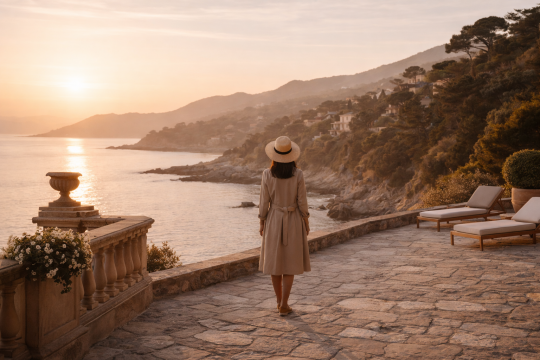
Coastal regions before peak season offer a natural quiet. Towns along the Mediterranean in April, for example, are awake but not yet animated. The sea is present, the air carries warmth, but the intensity of summer has not arrived.
In rural landscapes, whether vineyards in northern Italy or open terrain in Argentina, space becomes physical as well as psychological. Distances stretch. Sound softens. Time feels less segmented.
Even cities can offer this, if approached differently. Early mornings in places like Lisbon or Kyoto reveal a version of urban life that feels almost private.
The key is not isolation, but balance. Enough presence to feel alive, enough space to remain unpressured.
The Role of Design in Slowing Down
Where you stay becomes central to how this unfolds.
Spaces that encourage stillness tend to be intentional in their design. Clean lines, natural materials, and a strong connection to the surrounding environment create an atmosphere that does not demand distraction.
Rooms are not just functional, they are complete. Terraces extend living space outward. Windows frame rather than expose. Interiors hold attention without overwhelming it.
In these environments, there is less need to leave immediately. The act of staying becomes part of the experience.
This is where the earlier concept of design-led travel intersects with pace. The right space allows for a slower beginning without feeling static.
Letting the Destination Reveal Itself
A fast start often forces a destination into a predefined narrative. The slow opening does the opposite.
Instead of following a plan, travelers begin to notice patterns. When streets are busiest. Where locals gather. How light moves across a landscape throughout the day.
Decisions are made later, but with more clarity. A restaurant chosen after walking past it twice. A viewpoint discovered without searching for it. A neighborhood explored simply because it felt right.
This creates a different kind of connection. The experience feels less curated, more personal.
April as the Ideal Moment
Timing is what makes this approach viable.
In peak summer, stillness is harder to find. Energy builds quickly, and environments respond to demand. In winter, certain destinations close in on themselves.
April sits between these extremes.
There is enough activity to feel engaged, but not so much that it dictates behavior. Weather supports time outdoors without urgency. Light extends the day without overwhelming it.
It is a month that allows for presence without pressure.
Closing Thought
Travel does not need to begin with movement to be meaningful.
By allowing space at the beginning, the rest of the journey shifts. Experiences feel less rushed, decisions more intuitive, and the destination itself becomes more legible.
In a time where travel is often optimized for efficiency, the slow opening offers something different, a return to awareness.
It is not about doing less. It is about beginning better.