The Beauty of Arrival
2026-07-27 Richard Shane
Founder and CEO
The World’s Greatest Vacations
There is a particular kind of travel memory that begins before the destination itself. A train slowing as it enters a valley. A ferry approaching a harbor in early light. A car following a mountain road as the air changes through an open window. A small aircraft descending over islands, forests, or desert. These moments are not merely logistical. They are part of the emotional architecture of a journey.
For a long time, luxury travel tried to shorten this part of the experience. Transfers were made seamless, flights more direct, arrivals more private, and waiting time reduced wherever possible. Efficiency still matters. But increasingly, the most memorable journeys are not only about where one stays. They are also about how one arrives.
The beauty of arrival is returning as a form of luxury.
When the Journey Becomes Part of the Place
Some destinations reveal themselves immediately. Others ask to be approached slowly. A coastal village seen first from the water feels different from one reached by road. A mountain retreat becomes more powerful when the ascent has been part of the day. A historic city entered by train, with rooftops and stations appearing gradually, carries a different emotional charge than one met through a hotel lobby after a hurried transfer.
This is not nostalgia. It is attention. The way a traveler approaches a place shapes the way that place is understood. Movement creates context. It shows the geography, scale, weather, light, and distance that a destination occupies in the world.
Luxury travel has always been concerned with access, but the most thoughtful version of access does not erase the journey. It gives it dignity.
The Slow Reveal
Part of the pleasure lies in anticipation. Modern life offers very little of it. So much arrives instantly, messages, images, plans, confirmations, directions. Travel, at its best, restores a more gradual sense of discovery.
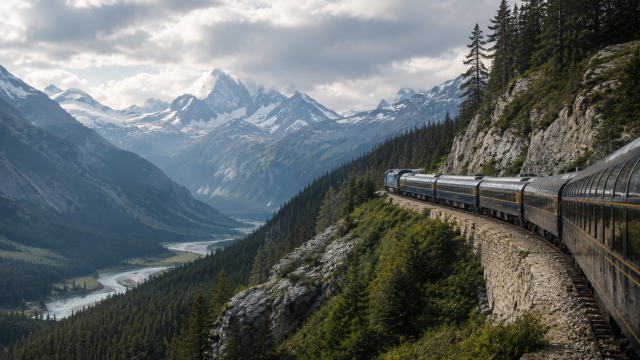
A train journey does this naturally. The view changes hour by hour. Cities become fields. Fields become hills. Hills become mountains. The traveler does not need to perform the experience. Sitting still is enough. The landscape does the work.
Ferries and small ships offer a different form of arrival. They slow the body down before the destination begins. Harbors, cliffs, islands, and shorelines appear at a human pace. The traveler watches the place take shape, first as a line, then as architecture, then as detail. By the time one steps ashore, the destination already feels connected to the journey.
Scenic roads can be equally powerful. A private car transfer through wine country, forest, desert, or alpine terrain allows the traveler to move through transitions that would otherwise be missed. The road becomes a thread between climates and cultures. A great drive is never simply a way to get there. It is part of the there.
Transport as Experience, Not Interruption
The most sophisticated travel planning increasingly treats transportation as part of the itinerary, not a gap between meaningful moments. This is especially true for journeys built around rail, expedition cruising, private aviation, classic cars, riverboats, yachts, or carefully designed road transfers.
When done well, these experiences are not about display. They are about continuity. The mood of the trip begins before check-in. A rail compartment with good service, a quiet lounge before a private flight, a beautifully planned road transfer with stops chosen for view and character, or a small vessel approaching a remote coastline can all extend the feeling of being cared for.
There is also a practical elegance to this approach. Travel days no longer feel wasted. They become scenic, restorative, and emotionally coherent. The traveler is not simply being moved. They are being introduced.
The Return of Romance
Arrival has always carried a certain romance, but luxury travel sometimes hid it beneath convenience. The most direct route is not always the most memorable one. The fastest arrival is not always the most beautiful.
There is romance in seeing a destination before entering it. In recognizing the silhouette of a city from across the water. In hearing the shift in language at a railway station. In watching the landscape grow unfamiliar mile by mile. These moments create a sense of threshold, the feeling that one is passing from ordinary life into another atmosphere.
This is especially valuable now because so much of travel is mediated through images before it is experienced in person. Travelers often know what a hotel, beach, restaurant, or landmark looks like long before they arrive. The journey itself remains harder to preview. It can still surprise.
Designing the First Impression
The best hotels and travel companies understand that arrival is not a single moment. It begins earlier than the door. It starts with the route, the vehicle, the first view, the pace, and the transition from public world to private experience.
A great arrival feels choreographed without seeming theatrical. The final stretch of road may open suddenly to water. A boat may approach a dock in silence. A train may pull into a small station where the hotel is already waiting. A desert property may appear slowly against the horizon. The guest feels not rushed into the experience, but received by it.
This kind of planning requires restraint. The goal is not to create spectacle, but to let the place announce itself with the right amount of distance and grace.
A More Complete Journey
When arrival is treated with care, the entire trip feels more complete. The destination no longer begins abruptly. It unfolds. The traveler has time to shed the pace of daily life and enter the rhythm of the place ahead.
That may be why slower, more scenic forms of arrival feel so relevant now. They answer a desire that is difficult to name but easy to recognize, the desire for travel to feel less fragmented. Not merely a sequence of bookings, rooms, meals, and views, but a continuous experience with a beginning, a middle, and a sense of movement.
There will always be times when speed matters. A direct flight, a quick transfer, a private arrival after a long journey, these remain valuable. But there is growing elegance in choosing the route that gives the destination room to appear.
Sometimes the first true luxury of a trip is not the suite, the meal, or the view from the terrace. It is the moment before arrival, when the landscape opens, the pace changes, and the journey begins to feel inevitable.