The New Coastal Rhythm: Destinations That Prioritize Space Over Scene
2026-05-18 Richard Shane
Founder and CEO
The World’s Greatest Vacations
For years, coastal travel was defined by visibility. The right beach club reservation, the busiest promenade, the destination everyone else seemed to be chasing at the exact same moment.
Lately, that version of luxury has started to feel strangely exhausting.
A quieter coastal rhythm is emerging instead, one that values atmosphere over attention, space over spectacle, and environments that feel restorative rather than performative. Travelers are becoming more selective about energy. The appeal is no longer centered around being where everything is happening, but around finding places where nothing needs to happen at all.
The coastline itself is becoming the destination again.
The Shift Away from High-Visibility Travel
Many of the world’s classic coastal destinations still carry undeniable beauty, but increasingly, travelers are engaging with them differently. The focus has shifted away from density and toward pacing.
People want mornings that begin slowly. Walkable coastlines instead of crowded promenades. Architecture that blends into the landscape rather than dominating it. Restaurants where the experience extends naturally over several hours instead of turning tables as quickly as possible.
The atmosphere matters as much as the location itself.
That change is influencing everything from hotel design to where travelers choose to stay within a region. Smaller-scale properties are becoming more desirable, especially those that feel rooted in place rather than built for visibility.
Space Changes the Experience
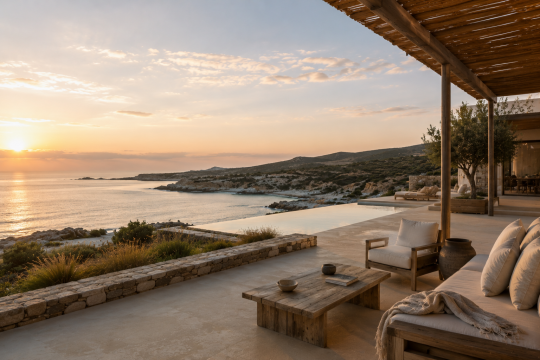
The defining luxury along today’s coastlines is often surprisingly simple, uninterrupted space.
A wide terrace facing open water. A nearly silent beach in the early evening. A long coastal road with no urgency attached to it. These moments alter the emotional pace of travel almost immediately.
Without constant stimulation, travelers begin to notice more. Wind moving through grasses. The sound of water instead of music. The changing quality of light throughout the day.
It becomes easier to settle into a destination rather than consume it.
That emotional shift is what many travelers are actually searching for, even if they describe it differently.
Architecture That Lets the Landscape Lead
The most compelling coastal properties today tend to share a certain restraint.
Materials remain natural and tactile, pale stone, weathered wood, linen, textured plaster. Interiors are quieter. Color palettes are softened by the surrounding environment rather than competing with it.
There is also a growing emphasis on horizontality and openness. Buildings sit lower against the landscape. Outdoor living spaces become extensions of the interior rather than separate zones. Windows frame coastline and sky as if they were part of the design itself.
At sunrise and sunset, these spaces transform almost entirely through light alone.
The effect feels cinematic without trying to be.
Destinations Moving in This Direction
Some coastlines are particularly aligned with this slower, more intentional style of travel.
Parts of the Greek islands beyond the primary tourist circuits continue to evolve toward understated luxury, where architecture, landscape, and pacing feel naturally connected. Portugal’s Atlantic coast has developed a similarly refined atmosphere, emphasizing openness, design, and a strong relationship with the surrounding terrain.
In Baja California, the contrast between desert and ocean creates a kind of visual minimalism that naturally encourages restraint. Meanwhile, certain northern European coastal regions are redefining luxury entirely through mood, weather, and solitude rather than traditional beach culture.
Despite their differences, these places share one important quality, they leave room for silence.
A Different Relationship With Time
Coastal environments naturally soften structure.
Meals stretch later into the evening. Plans become more flexible. Walking replaces scheduling. Even the way light moves across the day changes how people engage with time.
The most refined coastal experiences understand this instinctively. They are not built around keeping travelers occupied every minute. Instead, they create environments where simply being present feels sufficient.
That may be why these destinations feel increasingly valuable now. In a world designed around acceleration, coastlines still allow for drift.
Not aimlessness, but release from constant momentum.
The future of coastal travel will likely become even quieter, not because travelers want less from the experience, but because they want something more lasting from it.
More calm. More atmosphere. More connection to place.
And perhaps most importantly, more room to actually feel the destination once they arrive.