The Quiet Return of the Grand Summer Journey
2026-06-01 Richard Shane
Founder and CEO
The World’s Greatest Vacations
There is a particular kind of summer travel that does not begin with a checklist.
It begins with a route. A sense of movement. A desire to let one place lead naturally into the next, without rushing the experience or reducing it to a collection of reservations. For a growing number of travelers, the most desirable summer escape is no longer a single destination, but a beautifully paced journey.
The grand summer journey is returning, quietly and with more restraint than before.
It is not about excess. It is not about seeing as much as possible. It is about giving travel room to breathe. A few carefully chosen places, connected by scenic roads, rail lines, coastlines, rivers, or mountain passes. Time to arrive properly. Time to absorb the landscape. Time to feel the difference between one place and the next.
After years of compressed itineraries and short escapes, this slower, more expansive style of summer travel feels newly relevant.
The Pleasure of Traveling With Rhythm
A grand summer journey has a rhythm that a conventional vacation often lacks.
It might begin with a few days in a historic city, continue through wine country or open countryside, then end at a quiet coastal hotel or mountain retreat. The experience is not defined by one dramatic arrival, but by the gradual unfolding of the trip itself.
Each stop has a role. A city provides energy and culture. A rural stay offers space and stillness. A coastal village changes the pace again. A mountain hotel gives the journey a sense of arrival and retreat. When planned well, the route feels less like a schedule and more like a composition.
This is what makes the grand journey feel so appealing now. It allows travelers to move without feeling hurried. It creates variety without chaos. It gives each destination enough time to make an impression.
In summer, when the days are longer and the light softens slowly into evening, that sense of rhythm becomes part of the luxury.
Fewer Places, More Atmosphere
There was a period when ambitious travel meant covering more ground. More cities. More landmarks. More proof that the trip had been full.
The newer version of luxury travel is more selective.
A meaningful summer journey might include only three or four stops, but each one is chosen with care. A lakeside hotel known for its morning light. A restored estate surrounded by gardens. A small harbor town with excellent restaurants and no need for a plan. A contemporary lodge built into the landscape rather than placed on top of it.
The point is not to reduce travel, but to make it more memorable.
When there are fewer transitions, each one matters more. The drive through the valley becomes part of the day. The train ride along the coast becomes part of the story. The pause between destinations becomes something to enjoy rather than something to endure.
This is where atmosphere begins to matter more than activity. Travelers are not simply asking what they can do. They are asking what a place feels like, how it changes from morning to evening, and whether it gives them a reason to slow down.
The Journey Itself Is Becoming Desirable Again
For many years, transportation was treated as the least interesting part of travel. It was the practical middle, the thing to make faster, smoother, and less noticeable.
That is changing.
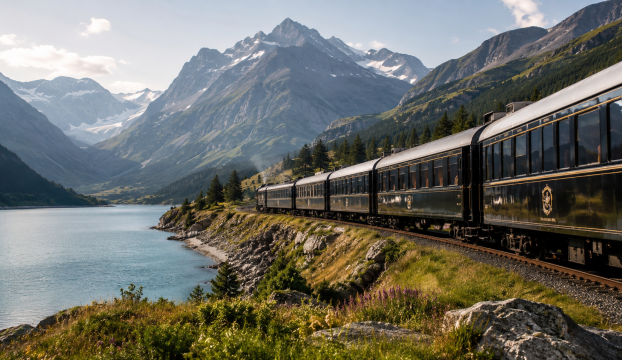
The route itself is becoming part of the experience again. Scenic rail journeys, private road transfers, small-ship sailings, and thoughtfully planned drives are attracting travelers who want the landscape to reveal itself gradually. There is a different kind of anticipation in watching the terrain change, from city streets to open fields, from forest to coast, from lowland heat to alpine air.
This is especially true in regions where geography creates natural drama. Switzerland, Norway, Scotland, Japan, Canada, Portugal, New Zealand, and parts of South America all lend themselves to journeys where the space between destinations is as memorable as the destination itself.
The most elegant routes do not feel complicated. They feel inevitable.
A traveler may begin in a city, follow a river, cross a mountain pass, and arrive somewhere quiet by evening. Nothing about that experience feels accidental. The pleasure is in the progression.
Classic Summer Landscapes, Seen Differently
The return of the grand summer journey also brings renewed attention to classic summer landscapes.
Lakes, coastlines, alpine valleys, countryside estates, old rail towns, garden hotels, and historic harbors have always held a certain seasonal appeal. What feels different now is the way travelers are approaching them. The desire is less formal, less showy, and more personal.
A grand hotel may still be part of the itinerary, but so might a small design-led inn. A famous coastal region may still be included, but perhaps from a quieter base. A mountain destination may be chosen not for its name, but for its architecture, views, walking trails, and sense of calm.
This gives familiar landscapes new life. The appeal is not nostalgia for an older style of travel. It is the rediscovery of places that reward patience.
A lakeside morning. A shaded lunch terrace. A road bordered by cypress, lavender, or pine. A harbor before the day’s visitors arrive. A hotel lobby that still uses real keys. A train platform in the early evening. These details are small, but they are often what remain most clearly after the trip is over.
Time as the Real Luxury
The grand summer journey depends on something that has become increasingly rare, unclaimed time.
Not every day needs to be structured. Not every afternoon needs an excursion. Not every destination needs to be justified by a list of things to see. In fact, the most luxurious itineraries often include space that appears empty on paper.
That space is where travel becomes personal.
It allows for a longer breakfast, a second walk through the same neighborhood, an unplanned stop at a roadside cafe, or an hour spent reading beside an open window. It allows travelers to notice the mood of a place rather than simply move through it.
For couples, families, and small groups, this can change the entire feeling of a trip. A journey with room in it feels less like an obligation and more like a shared experience. There is less pressure to perform the vacation and more opportunity to actually enjoy it.
This may be one reason the grand summer journey feels so modern, despite its old-world associations. It answers a very current desire, not for more luxury in the obvious sense, but for more ease.
A Softer, More Considered Way to Travel
The grand summer journey does not have to be long. It does not need to cross continents or last for a month. Its defining quality is not scale, but pacing.
Ten days can be enough. Two weeks can feel expansive. Even a shorter route can carry the feeling of a grand journey if it is planned with care, contrast, and breathing room.
The best versions are built around transitions that feel natural. City to countryside. Coast to island. Valley to mountain. Old-world hotel to contemporary retreat. Cultural immersion to complete quiet. Movement to stillness.
This kind of travel asks less of the traveler in some ways, but gives more back. It does not demand constant attention. It allows the experience to settle.
That may be why it feels so right for summer. The season already invites looseness. Longer evenings, lighter clothes, open windows, outdoor meals, and the particular softness of travel without too much urgency.
The quiet return of the grand summer journey is not really about going back to an earlier age of travel. It is about restoring something that modern travel sometimes forgot, the pleasure of the in-between.
The road. The rail line. The pause. The changing view. The feeling that the trip has not simply begun or ended, but unfolded.