The Return of the Grand Journey: Why Longer, Slower Travel Is Back
2026-05-04 Richard Shane
Founder and CEO
The World’s Greatest Vacations
For years, travel has been defined by compression. Shorter trips, tighter itineraries, and a focus on maximizing time rather than experiencing it. The result has often been movement without depth, a series of moments rather than a cohesive journey.
That model is beginning to shift.
A growing number of travelers are returning to something more considered, the grand journey. Not in the traditional sense of distance alone, but in structure, pacing, and intent. Fewer trips, but longer. Less urgency, more continuity.
What is changing is not where people go, but how they move through it.
From Itinerary to Narrative
The difference between a trip and a journey is not length, it is cohesion.
Short-form travel often relies on highlights. A city reduced to a list. A region experienced through isolated moments. The grand journey reconnects these elements into something more fluid.
Routes are designed with progression in mind. Landscapes change gradually. Cultures shift in sequence. The experience builds rather than resets.
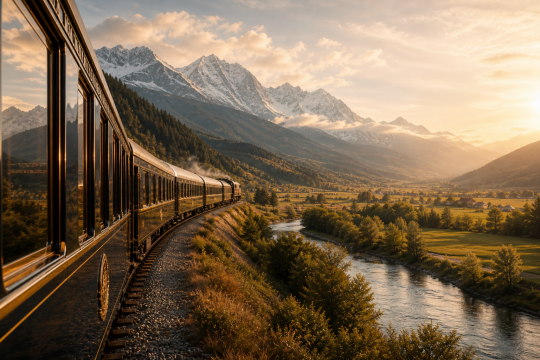
A coastal route that moves from village to village. A rail journey that transitions through regions without interruption. An overland itinerary that allows distance to become part of the experience rather than something to bypass.
The structure itself becomes meaningful.
Time as a Luxury
Length alone does not define this approach. It is how that time is used.
Longer journeys allow for variability. Days that are active followed by days that are not. Moments that are planned alongside those that are not anticipated.
This creates a different relationship with time. Instead of optimizing every hour, travelers begin to move within a broader rhythm. Delays are less disruptive. Discoveries feel less incidental.
Luxury, in this context, is not about access, it is about margin. The ability to adjust, to extend, to pause.
Seamless Movement, Not Constant Motion
One of the defining characteristics of the grand journey is continuity.
Movement is still present, but it is less fragmented. Fewer transfers, fewer interruptions, fewer abrupt transitions between environments.
Trains replace flights where possible. Drives follow natural geography rather than logistical convenience. Stays are extended, allowing destinations to be experienced rather than sampled.
This reduces friction. The journey feels smoother, more integrated. Travel becomes less about getting somewhere and more about moving through.
The Role of Design and Planning
Paradoxically, slower travel often requires more thoughtful planning.
Routes need to make sense geographically and experientially. Transitions should feel natural. Accommodations must support longer stays, not just short visits.
Design-led properties become more important in this context. Spaces that can be lived in, not just passed through. Environments that maintain interest over time.
At the same time, the structure must remain flexible. The itinerary guides, but does not dictate. The journey evolves.
Destinations That Reward Depth
Certain regions are particularly suited to this approach.
Southern Europe, where distances are manageable and transitions between landscapes are gradual. Japan, where rail infrastructure allows for seamless movement across distinct regions. South America, where scale encourages extended exploration rather than quick passage.
These are places where the journey itself can hold attention. Where moving from one point to another does not feel like a gap, but an extension of the experience.
A Shift in Travel Priorities
Underlying this trend is a broader change in mindset.
Travel is no longer just about accumulation, of destinations, of experiences, of images. It is about integration. How those experiences connect, how they are remembered, how they are felt over time.
The grand journey supports this.
It creates space for continuity, for reflection, for a deeper engagement with place. It reduces the sense of fragmentation that often defines shorter trips.
Closing Thought
The return of longer, slower travel is not a rejection of modern travel, it is a refinement of it.
By extending time and reducing urgency, the experience changes. It becomes less about coverage and more about connection.
In a landscape where efficiency has dominated, the grand journey offers something different.
Not more travel, but better travel.