The Souvenir You Make Yourself
2026-08-24 Richard Shane
Founder and CEO
The World’s Greatest Vacations
Most souvenirs begin at the end of an experience. They are selected after the museum visit, placed beside the register at a hotel or discovered during a final walk through town. Their purpose is to carry a little of the destination home, although the connection is often created by purchase rather than participation.
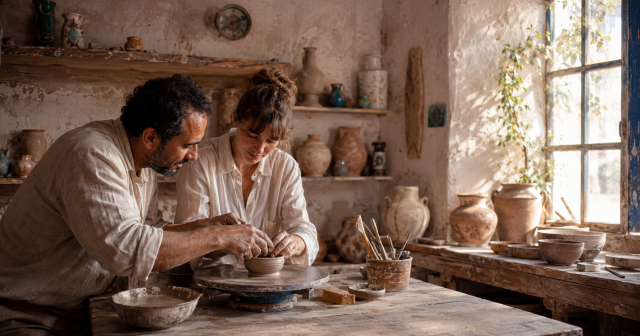
A different kind of souvenir begins much earlier. It starts with wet clay on a potter’s wheel, fragrant oils arranged across a perfumer’s table or threads waiting beside a wooden loom. The traveller does not simply choose the finished object. They spend time learning how it comes into being.
What returns home may be imperfect, but it holds something a polished purchase rarely can: the memory of making it.
From Observation to Participation
Travel has traditionally placed visitors on one side of an invisible line. They enter workshops, markets and kitchens to watch people whose knowledge belongs to the place. A demonstration may be fascinating, but the traveller remains an audience.
Hands-on experiences gently cross that line. A ceramicist explains how local clay responds to pressure. A cook demonstrates why dough should be folded rather than forced. A textile artist shows how a particular colour is extracted from a plant, then guides unfamiliar hands through the first uncertain steps.
The experience becomes physical. Texture, weight, temperature and repetition reveal details that observation alone cannot. It is one thing to admire a hand-thrown bowl. It is another to discover how easily clay loses its shape, and how much control is required to make something appear effortless.
This form of participation is becoming an important part of contemporary travel. Recent traveller research suggests that the skills gained during a trip often remain more meaningful than a material souvenir. The appeal is not novelty alone. It is the feeling of understanding a place through what its people know how to do.
Access Becomes the Luxury
The most compelling creative experiences are rarely the largest or most elaborate. They may take place in a quiet studio behind an unmarked door, at a family table or in a workshop where tools have occupied the same positions for decades.
Luxury, in this setting, is expressed through access and attention. It is an afternoon with someone willing to explain not only a technique, but the history and judgment behind it. A private fragrance session might begin with dozens of individual notes before revealing how a perfumer builds balance. A visit to a Japanese ceramics studio may include time with an artist whose work is usually encountered only in galleries. In Peru or Oaxaca, a weaving lesson can open a larger conversation about regional identity, natural dyes and patterns passed between generations.
These encounters cannot be rushed without losing their value. They require space in the itinerary, a knowledgeable guide or host and the willingness to remain in one place long enough for initial awkwardness to become concentration.
That slowness is part of the privilege. For a few hours, nothing else needs to be seen.
The Beauty of an Imperfect Object
Objects made while travelling are seldom flawless. A bowl may lean slightly. A printed pattern may not align perfectly. A hand-bound book might reveal where the thread tightened too much. These imperfections are precisely what distinguish the object from something selected in a boutique.
Its value is inseparable from the process. The uneven edge recalls the moment the clay began to collapse. A particular colour brings back the smell of the studio or the conversation that unfolded while waiting for pigment to dry. What appears modest to someone else can contain an entire afternoon for the person who made it.
The object also changes the story told after returning home. Instead of recalling where something was bought, the traveller can explain who taught them, what proved unexpectedly difficult and what the experience revealed about the destination.
This is not about replacing the work of skilled artisans. A few hours in a workshop cannot reproduce knowledge developed across years or generations. The handmade souvenir matters because it makes that expertise more visible. Attempting the work, even briefly, creates respect for what mastery requires.
Knowing When Participation Is Meaningful
Not every activity presented as cultural immersion offers genuine connection. Some reduce complex traditions to a decorative exercise, with little context and limited benefit for the people whose culture is being presented.
Thoughtful experiences tend to make their relationships clear. They are led by local practitioners, fairly compensate the people sharing their knowledge and treat tradition as something living rather than staged. The setting does not need to be polished, but the exchange should feel personal, informed and respectful.
Smaller groups often allow for better conversation. So does choosing an experience connected to the destination rather than an activity that could take place anywhere. Learning to prepare a regional dish with ingredients gathered nearby offers a different understanding than attending a standardized cooking class. Working with a material native to the landscape creates a connection between the object and its origin.
The best hosts do more than provide instructions. They explain why a method developed, how it has changed and what threatens or sustains it today. The finished object becomes a doorway into a much larger story.
The Skill That Travels Home
Sometimes the most valuable souvenir is not the item produced during the workshop. It is the beginning of a practice.
A traveller may return from Italy with the confidence to make pasta without a machine, or leave Morocco understanding how spices are layered rather than simply added. A photography walk can permanently change the way light is noticed. An introduction to flower arranging, calligraphy or woodcarving may become an interest that continues long after the trip.
The destination then remains present in ordinary life. Preparing a familiar recipe recalls the kitchen where it was learned. Mixing a fragrance brings back the first moment its notes came together. A newly acquired skill allows memory to be revisited through action rather than displayed on a shelf.
There will always be pleasure in finding a beautiful object made by someone else. Travel sustains craftspeople partly because visitors recognize the worth of their work and choose to support it. But making something alongside them creates a different relationship.
The object brought home may be small. The deeper souvenir is the time spent paying attention, the knowledge generously shared and the discovery that a place can be remembered not only by what was seen, but by what the hands learned to do there.