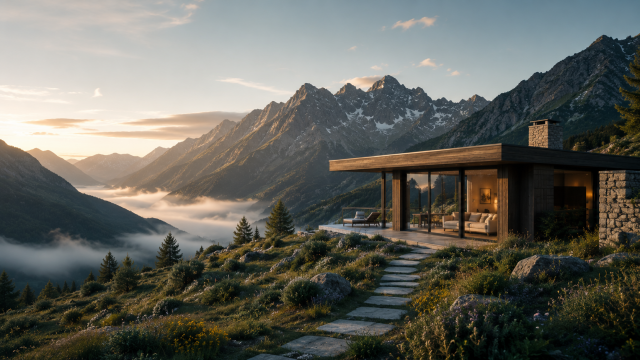
Where Mountain Air Meets Modern Luxury
2026-06-29 Richard Shane
Founder and CEO
The World’s Greatest Vacations
Mountain travel has always carried a sense of escape, but its appeal is changing.
For a long time, the mountains were treated mainly as a place for activity. Skiing, hiking, climbing, long drives, scenic viewpoints, and the familiar satisfaction of reaching higher ground. The landscape was the attraction, while the stay itself often played a secondary role.
That distinction is fading. Today’s most compelling mountain journeys are not only about what travelers do outside. They are about how the entire experience feels, from the architecture of the retreat to the clarity of the air, the pace of the day, the texture of the interiors, and the quiet that settles in after sunset.
Modern mountain luxury is not loud. It is elemental, restorative, and deeply connected to place.
The Mountain Retreat Reimagined
The idea of a mountain retreat has moved far beyond the traditional lodge.
Heavy timber, roaring fireplaces, and alpine nostalgia still have their charm, but many travelers are now drawn to a more refined interpretation. Clean-lined architecture. Large windows. Natural materials. Quiet rooms that frame the view rather than compete with it. Spaces designed for stillness as much as comfort.
The best modern mountain retreats do not try to dominate the landscape. They settle into it. A roofline follows the slope. Stone appears to rise from the ground. Glass opens a room toward a valley, forest, or ridge. Interiors use wool, linen, wood, leather, and soft lighting to create warmth without excess.
The result is a different kind of luxury. Less decorative, more atmospheric. Less about display, more about the feeling of being protected within a vast landscape.
Fresh Air as a Luxury
One of the most powerful pleasures of mountain travel is also one of the simplest.
Air feels different at elevation. Cooler, cleaner, lighter. It changes the rhythm of the body almost immediately. Mornings feel sharper. Sleep often feels deeper. Even ordinary routines, coffee on a terrace, a walk before breakfast, an open window at night, become more memorable.
This is part of the renewed appeal of mountain destinations. Travelers are increasingly looking for places that offer relief from density, heat, noise, and overstimulation. The mountains answer that desire without needing to be remote in the extreme.
A well-chosen mountain retreat can create the feeling of distance while still offering exceptional comfort. It gives travelers the sense that they have stepped outside the pressure of daily life, without giving up the ease and refinement they expect from a luxury journey.
Design That Frames the Landscape
Mountain design is most successful when it understands restraint.
The view is already dramatic. The weather is already expressive. The changing light, passing clouds, shifting shadows, and scale of the surrounding terrain provide more atmosphere than any interior could manufacture.
For that reason, modern mountain hotels and residences are increasingly designed as frames. A bedroom may open toward a snow line. A spa may face the forest. A dining room may sit low against the hillside, allowing the mountains to remain the central presence. A pool may reflect the sky rather than announce itself as a feature.
This kind of design creates a calm relationship between inside and outside. The traveler remains aware of the landscape even during quiet indoor moments. Reading, dining, resting, and bathing all become connected to the place beyond the glass.
The luxury is not only in the view. It is in how carefully the view is held.
Wellness Without Performance
Mountain destinations have become closely linked to wellness, but the most appealing version is often understated.
It does not need to be built around strict programs, elaborate schedules, or a sense of improvement. For many travelers, wellness in the mountains is more natural than that. Long sleep. Cool air. Mineral water. A morning walk. Time in a sauna. A quiet swim. A meal that feels nourishing without being severe.
The environment does much of the work.
A day in the mountains can offer movement without intensity and rest without boredom. Travelers can be active in the morning, still in the afternoon, and quietly social in the evening. The pace feels healthier because it follows the landscape rather than a fixed idea of productivity.
This softer approach to wellness is especially attractive in summer, when mountain air offers a welcome contrast to crowded cities and hot coastal destinations.
Summer in the High Country
While winter mountain travel has long had a glamorous identity, summer in the mountains is becoming increasingly desirable.
The season reveals a different character. Meadows open. Trails become accessible. Lakes reflect longer days. Villages feel relaxed rather than formal. Terraces replace fireplaces as the center of daily life. The drama of the landscape remains, but the mood softens.
Summer mountain travel is also wonderfully versatile. It can be active or quiet, social or private, rustic or highly refined. A day might include a guided hike, lunch beside a lake, time at the spa, and dinner under a clear evening sky. Another might have no formal plan at all beyond a view, a book, and a slow meal.
This flexibility is part of its appeal. The mountains do not demand one kind of traveler. They offer space for different rhythms.
The Rise of the Architectural Hideaway
Some of the most interesting luxury properties in mountain regions are less like hotels and more like architectural hideaways.
They may be small, private, and carefully positioned. A contemporary chalet above a valley. A glass-walled retreat at the edge of a forest. A restored stone house in a remote village. A minimalist lodge reached by a winding road. These places appeal because they feel discovered rather than presented.
Privacy is part of the attraction, but so is perspective. A mountain hideaway gives travelers a particular way of seeing the landscape. Not from a busy viewpoint or crowded terrace, but from a place that feels personally held.
This sense of ownership, even briefly, is one of the quiet luxuries of mountain travel. The view becomes familiar. The morning light becomes expected. The path from room to terrace becomes part of the day’s rhythm.
Food, Fire, and Evening Rituals
Mountain luxury is often strongest in the evening.
After a day outside, even simple rituals feel elevated. A warm drink near a window. Dinner built around local ingredients. A fire lit as the temperature drops. A terrace wrapped in blankets. The sound of wind moving through trees or the silence that arrives after dark.
Food in mountain regions often reflects the same qualities travelers seek from the landscape, warmth, seasonality, and a sense of place. Alpine cheeses, lake fish, mushrooms, herbs, berries, game, fresh bread, and wines from nearby valleys can make a meal feel grounded and memorable without unnecessary complexity.
In the best mountain hotels, dining is not treated as a separate luxury. It is part of the larger atmosphere of shelter, altitude, and seasonal comfort.
A Quieter Definition of Escape
The modern appeal of mountain travel lies in its balance.
It offers grandeur without crowding the traveler. It offers activity without pressure. It offers privacy without emptiness. It offers design, comfort, and service while keeping nature at the center of the experience.
This is why mountain destinations feel so relevant now. They provide a form of luxury that is not dependent on constant novelty. The pleasure is older and more essential, clear air, open space, good sleep, beautiful materials, thoughtful architecture, and the steady presence of the landscape.
At a time when many travelers are looking for calm without sacrificing refinement, the mountains offer a compelling answer.
Modern mountain luxury does not ask for attention. It creates space for attention to return. To the weather. To the view. To the body. To the quiet. To the simple pleasure of being somewhere high above the noise, breathing a little more deeply.